Angels and Archangels
Each angel ( or
or  ) can capture any opponent’s piece (including the opponent’s archangel) located on one of the “Gates of Heaven” squares, if the dice roll allows such movement (see Capturing a Gate of Heaven). When an opponent's piece is captured there, it is banished to a vacant “Sheol” square. The capturing player decides which vacant “Sheol” square should be used for the banishment.
If no “Sheol” square is vacant (due to capturing actions of previous turns), the capturing player can release any of its own pieces that are currently imprisoned in “Sheol”, as explained in the next section. Capturing on other locations of the board is prohibited for angels (see also: Escaping from the Sheol).
Each archangel ( or
or  ) can move and capture exactly like an angel (depending on the dice roll result), but it also has the following special abilities:
-
Can swap its location with any of the other 6 angels that are owned by the same player as its turn, regardless of the dice roll result. This option is generally used when no advantageous move is available, or when the player is working toward capturing an opponent’s piece outside of the “Gates of Heaven”.
-
Can capture an opponent’s piece on any location outside of the “Gates of Heaven” and “Sheol”, by legally moving to that location (if the dice roll allows such movement) and acting as follows:
-
When an angel is captured by an archangel, the capturing player can place the captured angel on any location on the board, except the “Gates of Heaven”, “Sheol”, and Throne of God” squares.
-
When an archangel is captured by another archangel, they only exchange positions on the board. The capturing archangel takes the place of the captured archangel, and the captured archangel is moved to the square from which the capturing archangel attacked.
-
For example:
If the dice rolls 1, an archangel on Remiel 7 can capture the opponent’s archangel on Raguel 6, and the captured archangel is placed on Remiel 7.
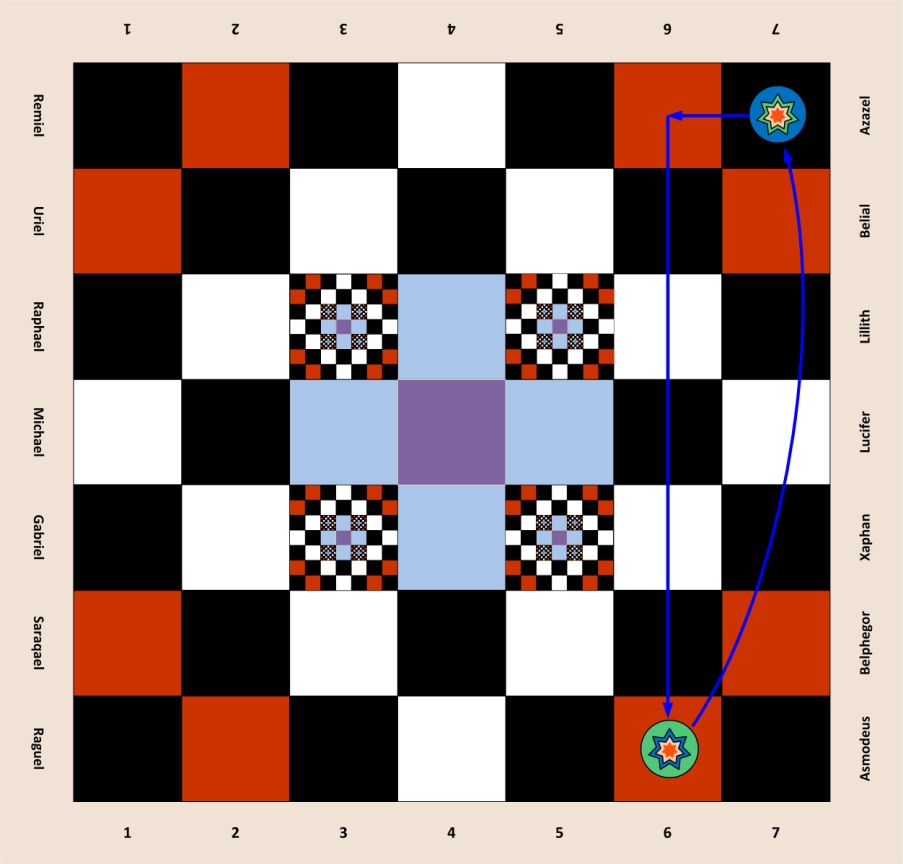
Such a replacement is not allowed when the captured archangel is on a “Gate of Heaven” (in such a case, the opponent’s archangel is banished to a “Sheol” square like any other piece, as previously described).